For most established nurseries, the end of the third quarter is when budget planning for next year begins. It is also when upgrading equipment stops being a hypothetical and becomes a line item that has to be justified: what does it cost to do nothing, compared with what it costs to act now?
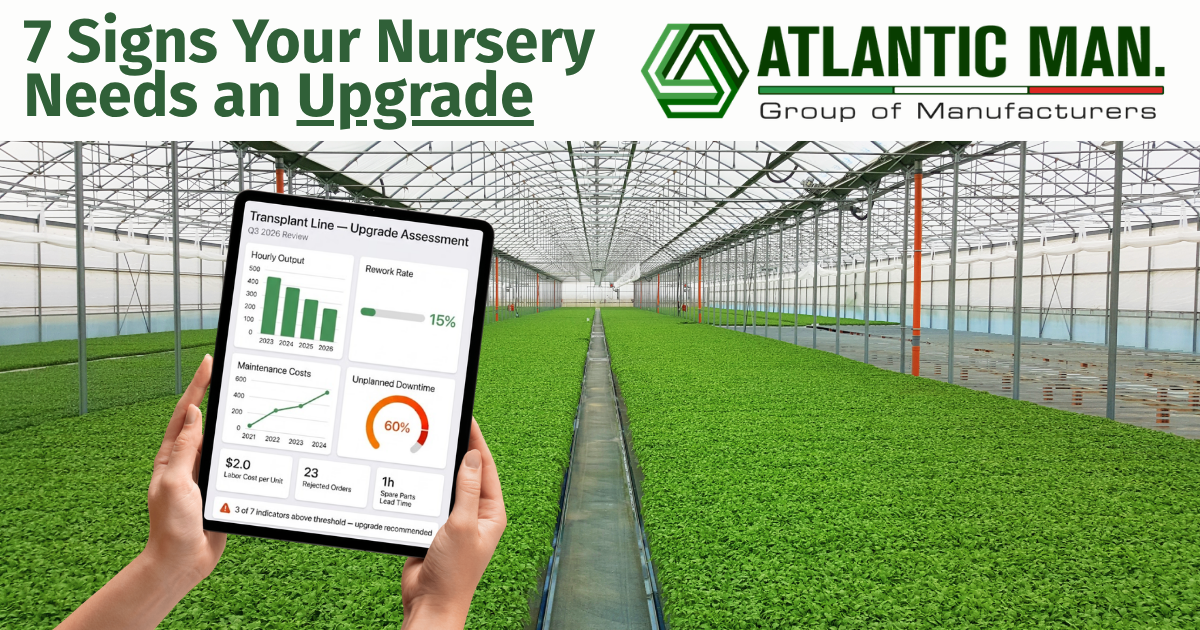
At Atlantic Man. we help nurseries of all sizes through exactly this evaluation every year, and the cases where an upgrade turns out to be truly necessary almost always share a handful of warning signs. The challenge is that machines like a transplanting line or an automated seeding system rarely fail outright. They tend to wear down quietly, still running but with steadily less efficiency, precision and reliability. The table below sets out seven concrete signs to check before you finalize your 2027 budget.
The seven indicators
| # | Warning sign | What to look for | Question to ask yourself |
|---|---|---|---|
| 1 | Struggling at peak season | Late deliveries, regular overtime or turned-down orders for two or three seasons running, with the bottleneck always at the same stage (potting or tray filling, for example) | Does the hourly output promised at purchase still match what the line delivers at peak demand? |
| 2 | Rising repair costs | Yearly spending on spare parts and repairs creeping towards 15-20% of the machine's replacement value, and climbing every year | Over the past 24 months, has repair spending on each component been going up? |
| 3 | The same part keeps failing | Repeated downtime traced back to the same component (substrate doser, gripper unit, tray feed conveyor), often one the supplier no longer stocks | Is most of this year's unplanned downtime down to one identifiable component? |
| 4 | Declining precision | Uneven substrate dosing, plants that are not properly centered, patchy germination: all early symptoms of a mechanical failure to come | Are your people spending more time fixing things by hand at the end of the line than they did two or three seasons ago? |
| 5 | Limited flexibility | Slow changeovers, frequent manual adjustments, non-standard orders you have to refuse, even though your product mix has moved on | How many orders did you turn down or change last year because your equipment could not handle them? |
| 6 | Stagnant labor productivity | Labor cost per seeded tray that refuses to come down, even though the rest of the nursery has become more efficient | Compared with three years ago, is your labor cost per unit flat, lower or higher? |
| 7 | Spare parts running out | Longer waits for spare parts, or components the manufacturer has discontinued | Can your supplier still deliver every critical part fast enough to fit your growing season? |
Why raise these points in your budget discussions now
On its own, none of these signs justifies an investment. But when several appear together, the argument stops being a gut feeling and becomes a documented business case, which is what any request needs if it is going to compete with other company priorities. Planning an upgrade now, months before the next production cycle, gives you the time to choose a supplier, design the solution and install the new equipment properly. That breathing room disappears when the decision is forced by an unexpected breakdown.
In our experience, this kind of assessment also works best with someone who understands both the engineering and the realities of nursery production. You do not always need to replace the whole line: sometimes upgrading a single functional unit is enough to bring the equipment back up to spec.
Talk to our team
If more than one of these signs sounds familiar, the best way to turn them into a case for your budget is a direct technical conversation. The Atlantic Man. team has spent years designing and installing equipment for nurseries and horticultural growers, supporting customers from the first needs analysis through to after-sales support. That means we see up close both the systems that are still performing well and those that have reached their limits.
This hands-on experience, built up across businesses of different sizes and specializations, helps us tell a management problem from an equipment problem. Not every case calls for a full line replacement, and a proper technical assessment always starts with the real numbers, not with the age of the machine or a vague impression.